





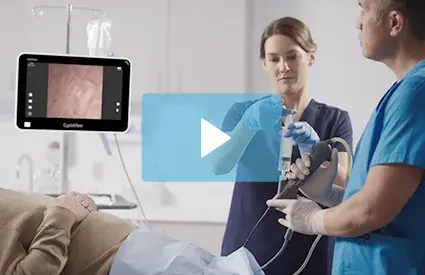
The following is a compendium of recent airway management guidelines published by a diverse set of medical societies. These guidelines recommend routine use of video laryngoscopes in tracheal intubation, summarizing evidence-based clinical value, safety advantages, and recommendations for use in routine and difficult airway management strategies.
CLINICAL REFERENCE
Airway Management Guidelines Support Routine Use of Video Laryngoscopes
ANESTHESIOLOGY

DAS
Difficult Airway Society
A video laryngoscope should be used first-line to facilitate tracheal intubation whenever possible.
1
Airway managers should attain and maintain competence in use of video laryngoscopes available in their department.
ANESTHESIOLOGY

PUMA
Project for Universal Management of Airways
Routine use of a video laryngoscope is recommended whenever feasible.
2
Video laryngoscopy improves glottic view and reduces the risk of unrecognized esophageal intubation.
ANESTHESIOLOGY

SOBA
Society for Obesity and Bariatric Anaesthesia
A video laryngoscope should be used as a first-line technique (Grade A, strong recommendation).
3
Preferably a hyperangulated blade when the user is sufficiently trained (Grade C, strong recommendation).
ANESTHESIOLOGY

SFAR
French Society of Anaesthesia and Intensive Care (Medicine)
A video laryngoscope as the first-line device rather than a direct laryngoscope in order to reduce complications with tracheal intubation.
4
Recommended to use video laryngoscopy as first option for patients with anticipated difficult intubation.
PEDIATRICS & NEONATOLOGY

AHA / ILCOR
American Heart Association / International Liaison Committee on Resuscitation
Infants being intubated at birth or on a neonatal unit, we suggest the use of video laryngoscopy.
5
Suggested where resources and training allow, especially in settings where less-experienced clinicians are intubating.
PEDIATRICS & NEONATOLOGY

BJA / ESAIC
British Journal of Anaesthesia / European Society of Anaesthesiology and Intensive Care
Use a video laryngoscope with an age-adapted standard blade as first choice for tracheal intubation.
6
Use a stylet to reinforce and preshape tracheal tubes with hyperangulated blades.
Share this post